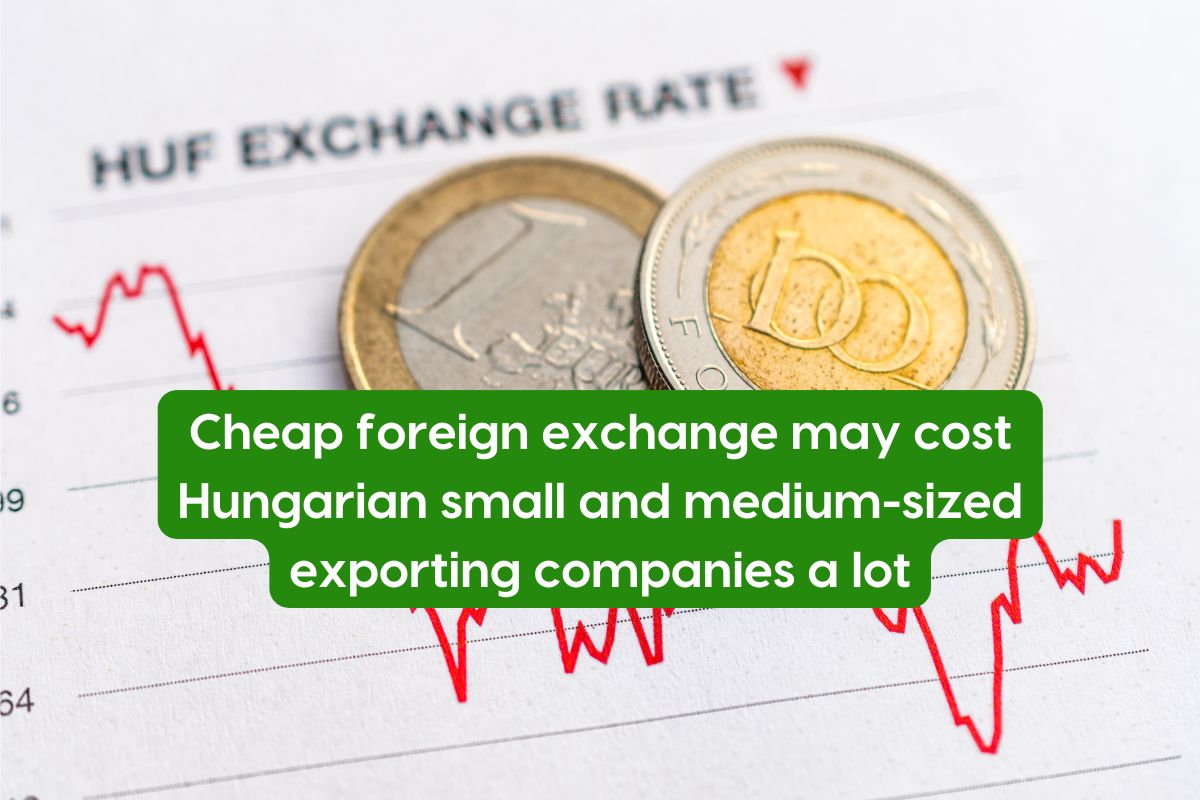
Shippers who settle most of their revenues in foreign exchange and pay fixed costs in forint are hurt by the strengthening forint because they do not gain as much from the falling inflation as they lose from their forint revenues. Meanwhile, China, ignoring the difficulties of maritime trade, continues to spin world trade.
The Hungarian forint, the national currency of Hungary, has strengthened significantly. A year ago, the euro was exchanged for around 400 forints, while in June this year the Hungarian currency strengthened to around 350 forints/euro. This represents a forint strengthening of over 11 percent in one year, and 7.2 percent since January this year. The situation is similar against the US dollar, and this time the forint was able to strengthen against regional currencies as well.
Hungarians generally believe that a strong national currency is good for almost everyone. Those who go on holiday abroad can stay there, eat and drink things that they could not afford to buy at the previous exchange rate. Imports become cheaper, which curbs inflation. The national debt is decreasing when calculated in forints.
In a peculiar way, the government is nevertheless clearly not happy with the situation. According to a statement by András Kármán, the newly appointed Minister of Finance, the government is not interested in further strengthening of the forint, but primarily in closing the gap between domestic and foreign interest rates.
Hungarian companies engaged in exports may be left reeling
It is a well known law of economics that an exchange rate that is good for importers is bad for exporters. At this time last year, Hungarian small and medium-sized companies selling their products and services abroad received 390 forints for every euro of their revenue, while in June 2026 they will have to make do with 350-360 forints.
In contrast to the declining revenue, their expenses calculated in forint, such as their wage costs, continue to increase, even if they do not have to count on as much inflation as before. Companies with low profit margins may quickly find that their costs exceed their revenue. The question is, how long can the forint’s momentum last?
There are several reasons for the recent strengthening, wrote Gábor Regős, chief economist and manager of a popular Hungarian investment fund, in his foreign exchange market analysis. One factor is the dollar, which is weakening at times due to geopolitical reasons, which supports the forint exchange rate. The other is the interest rate decision of the Hungarian Central Bank (MNB). The central bank did not reduce its base rate, citing inflationary pressure stemming from the runaway energy prices.
Another domestic factor is the anticipated investor confidence in the new government and the favorable industrial production. Experts say that the market has priced in all possible foreign circumstances and further government and central bank steps into the exchange rate. Therefore, no further significant strengthening of the forint is expected, however, the forint is stronger than ever. The question is whether the MNB will initiate its long-awaited interest rate cut cycle. There are different expectations about this on the market.
Hungarian exporters in trouble: China continues its export offensive unwaveringly
Experts monitoring supply chains could see in the first quarter of 2026 that world trade is ignoring the problems that complicate transportation. Container ships are still practically unable to pass through the Red Sea, the Strait of Hormuz was closed by the Iranians, but still – or perhaps precisely because of this – more and more containers set off on the world’s oceans.
The direction of sea freight transport decreased on the main China-United States route, while it grew in all other directions. However, the diversification of the Asian country’s exports is not a response to the increased US tariffs, but a process that has been going on for years, said Nigel Pusey, CEO of Container Trade Statistics (CTS) in the podcast of the shipping company Dimerco.
In the first quarter of this year, 46.2 million TEUs of goods sailed the world’s oceans, which is 4.4 percent more than in the same period last year, according to CTS data. If Middle Eastern trade had not been disrupted by the war between Israel and the US and Iran, the growth could have been 6 percent. The armed conflict, which began at the end of February, erased 840,000 TEUs from world shipping traffic.
China is turning away from the United States. China is turning away from Europe. China is facing the rest of the world.
In the first three months of 2026, container traffic from the Far East to the United States fell by 4%compared to the beginning of 2025. Within this, the CTS saw a 10% drop in trade between China and the United States. This was partly offset by increased American traffic from other Southeast Asian countries, which grew by around one million TEU. Half of this increase came from Vietnam, a third from Thailand, and 10–15 % from Cambodia. Opinions are divided on the extent to which Chinese investors are behind this increase.
Chinese traffic did not disappear, but shifted towards other target markets. Transport between African countries and major Asian carriers increased by 33%in the first quarter. This mainly covers Chinese exports, primarily destined for the West African region. The expansion is being aided by improvements to African port infrastructure.
Latin America saw a 17 percent increase in goods from Asia. Most of these came to Brazilian ports. Shipments to India also increased by 17 per cent.
Transport traffic between the Far East and Europe grew by 15 percent in the first quarter of this year. In this context, the head haul to back haul ratio widened from 2.4:1 in 2023 to 3.5:1 in 2026. This represents an increase of almost 46 percent. In the first three months of the year, European exporters used only 34 per cent of the available transport capacity from Europe to the Far East. According to Nigel Pusey, this decline in German exports is the main reason for this.
Sources:
https://nepszava.hu/3325311_tul-eros-forint
https://granitalapkezelo.hu/grandioblog/negyeves-csucson-a-forint-okai-es-gazdasagi-hatasai/
LogMASter’s competitive service from the Far East
Our rail freight services from China with short transit times!
Need just a few pallets of goods from your Chinese supplier urgently?
We will import your shipment from China and deliver it to your door with customs clearance in 18 days!
Contact our colleagues at sales@logmaster.eu!